- Data & Analytics
- Education
Administrators now use AI more than students. The systems underneath have not caught up.
2026 is the first year university staff out-use students on AI. It is also the year it became obvious that the constraint was never the technology. It is that advising, enrolment, aid and billing still cannot see each other.

For three years the story about AI in higher education was a story about students, and mostly about cheating.
That story is now out of date. According to Inside Higher Ed's 2026 reporting on administrative AI adoption, administrators lead daily AI use in US higher education at 43%, the first year staff have out-used students, and the first year in which most members of every group report using it at least weekly.
Meanwhile a survey of more than 400 institutional presidents put AI ahead of enrolment decline, financial pressure and policy change as the most impactful force facing the sector by 2030. That is a remarkable ranking for institutions that have spent a decade genuinely worried about the demographic cliff.
So the demand question is settled. The interesting question is why so little of it has turned into institutional capability.
The answer is boring, and it is not the AI
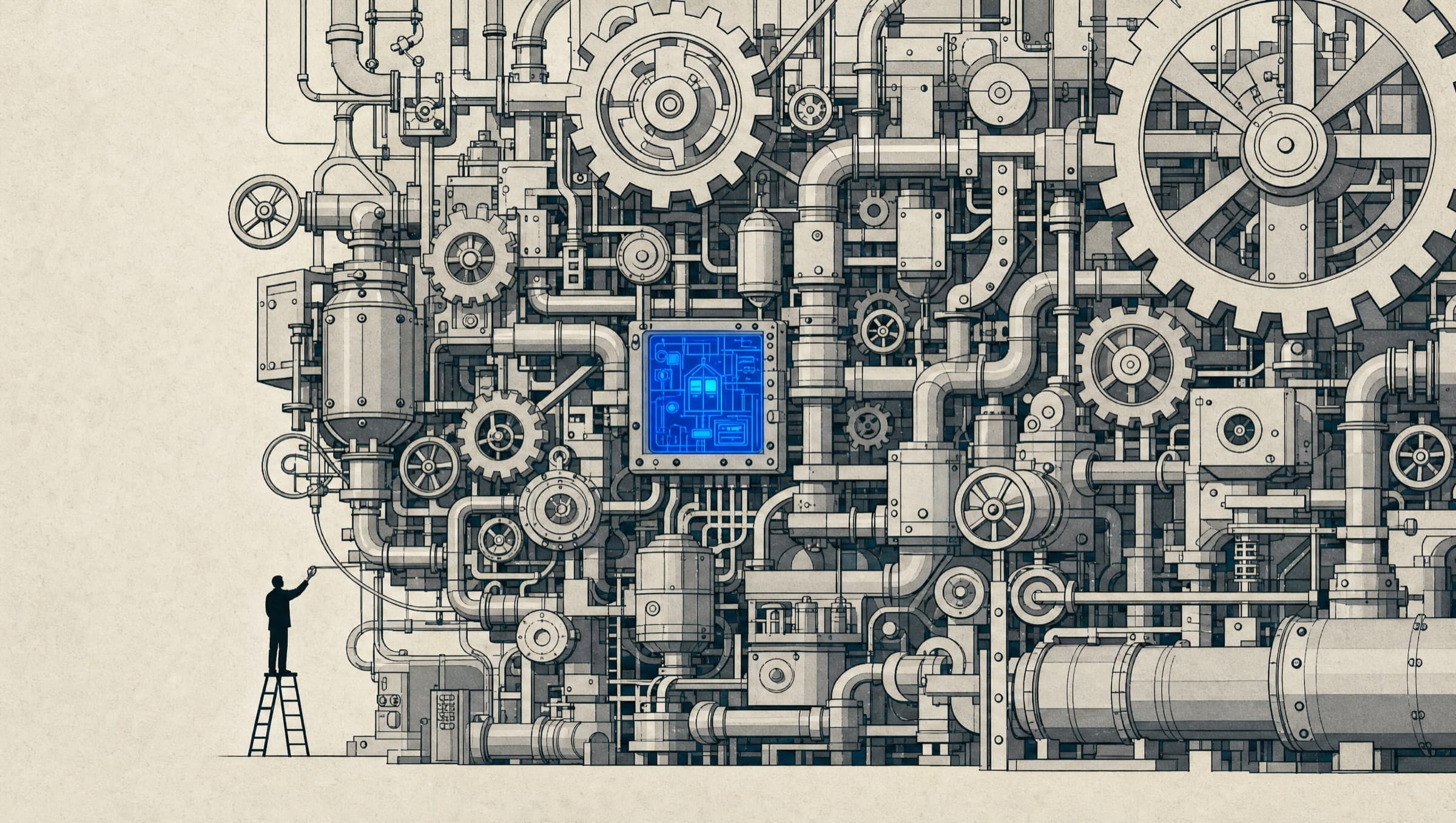
The barrier is that a university does not have a data problem. It has six of them, and they do not speak to each other.
Advising is one system. Enrolment is another. Financial aid is a third, usually the oldest and least accessible. The LMS is a fourth. Billing is a fifth. Student records sit under a registrar with entirely reasonable reasons to be cautious about who gets access to what.
Every one of these was bought separately, at a different time, by a different office, to solve a real problem. None of them was bought to answer a question that spans all six, and every question worth asking spans all six.
Which students are disengaging and have an unresolved aid issue and have not seen an adviser this term? That is the question retention turns on, and at most institutions answering it means three people exporting three spreadsheets and reconciling them by student ID over a week.
Inside Higher Ed's January 2026 predictions put this squarely on the agenda: Intellicampus CEO Joe Abraham predicted 2026 would be the year institutions moved to end system fragmentation and unify advising, enrolment and financial aid through workflow automation.
We would put it more plainly. You cannot deploy useful AI across an institution that cannot join its own records. What you get instead is six departmental chatbots, each confidently answering from a partial view.
The policy gap is really an awareness gap
There is a second finding in this year's data that is easy to misread.
The Inside Higher Ed reporting has formal institutional AI policies reaching 32%. Separate surveys of faculty find only around a quarter say their university has one, and a majority believe their institution is unprepared for AI integration.
Those numbers are usually quoted as though they measure the same thing and disagree. They do not. One counts policies that exist; the other counts people who know a policy exists. The difference between them is the finding.
A policy that lives in a governance document and has never reached the person deciding whether to paste a student's essay into a chatbot is not a control. It is a record of an intention. And the practical consequence is not abstract: staff use these tools anyway, 43% of them daily, and in the absence of a known rule they invent a reasonable-sounding one.
If your institution has a policy, the question worth asking this term is not whether it is good. It is what percentage of staff could describe it.
Three things that work before any AI is involved
We build systems for institutions, and the sequence that produces results is consistently unglamorous.
A student identity that resolves across systems. One student, one identifier, reliably joined across advising, enrolment, aid and the LMS. This sounds trivial and is usually the single largest piece of work, because the systems were never designed to agree, and because the mismatches are concentrated exactly in the population you care about: transfers, part-time students, name changes, returning learners. Nothing downstream is trustworthy until this exists.
An agreed definition of the terms. What counts as enrolled? On census date, or now? What is at risk? Two offices will have two definitions, both defensible and both in use. Automating on top of that disagreement produces confident, consistent, disputed numbers, which is the worst possible output, because it looks authoritative.
A path from signal to action. An early-warning model that identifies 400 at-risk students and routes them to an advising team with capacity for 60 has not helped anyone. It has produced a list, and lists that nobody can act on quietly train people to ignore the system. Design the intervention capacity first, then size the signal to it.
None of these require AI. All of them determine whether AI does anything.
Where AI genuinely earns its place
Once the foundations exist, three applications hold up in practice.
Grounded student support. A tutor that answers from the actual course material rather than the internet, and cites the lecture or reading it came from. The grounding is the entire product. A general-purpose chatbot will confidently answer a question the course answers differently, which is worse than no answer. This is what our own academic work was built to do, and the faculty-facing half, seeing which concepts a cohort is stuck on in week four rather than while marking finals, has turned out to matter as much as the student-facing half.
Administrative drafting. Correspondence, standard responses, first drafts of committee documentation. High volume, low stakes, a human signs. This is where the 43% is already going, informally and without governance.
Document processing in aid and admissions. Transcripts, verification documents, appeals. Genuinely repetitive, genuinely high volume, and with a natural review point downstream.
Note what is missing: anything that decides a student's outcome. Admission, academic standing, aid determination. Not because a model could not produce an answer, but because the institution has to be able to explain that answer to the student, to an appeals committee and sometimes to a regulator, and "the model scored you at 0.34" is not an explanation.
The disillusionment is coming, and it is healthy
One of the more useful predictions in the Inside Higher Ed piece came from Michigan's Rebecca Quintana, who expects growing AI disillusionment: students reporting fatigue, faculty seeing AI used in ways that undermine learning, and a partial return to foundational practice.
We think that is right, and it is not a bad outcome. Disillusionment is what follows the phase where every problem gets an AI answer, and it is usually when the durable work starts. The institutions that come out of it well will be the ones that spent this period fixing identity resolution and definitions rather than buying pilots.
Those foundations do not depreciate. They are just as valuable if the enthusiasm cools, which is precisely the argument for building them now.
The bottom line
Higher education's AI constraint is not model capability, faculty resistance or student misuse. It is that most institutions cannot answer a question that crosses two departments without a week of manual reconciliation.
Fix that and the AI applications become straightforward. Skip it and you get a collection of departmental pilots that each work in a demo and none of which change a retention number.
Administrators reaching 43% daily use is not the story. The story is that they got there without the institution getting any better at knowing things, and that gap is what the next two years should be spent closing.
If your institution is trying to get to one answer instead of six, that is the work we do, and grounded student support is what becomes possible once that foundation holds.